![amplFC = CreateFCAmp[mesontreeinsert, EqualMasses -> False, Sum -> True] ;](../HTMLFiles/index_81.gif)
Calculation of the amplitude:

![amplFC2 = CheckF[(summ = SUNReduce[SUNReduce[#]] & /@ (Print["Expanding..."] ; tmp = Expand[#] ; Print["Reducing..."] ; tmp) ; suminds = (#[[1]]) & /@ Union[Cases[#, _SumOver, Infinity]] ; sums = If[suminds === {}, {I1, 1}, Sequence @@ ((({#, If[FreeQ[summ, #], 1, 8]} & /@ suminds)))] ; Print["Length of expression: ", Length[summ]] ; tmpii = 0 ; res = (If[IntegerQ[tmpii/100], Print[tmpii]] ; ++ tmpii ; SUNReduce[SUNReduce[Sum[WriteOutUMatrices[#], Evaluate[sums]], Explicit -> True, HoldSums -> False]]) & /@ summ) & /@ Take[amplFC, {1, -1}], "KSPiCTs.1.m"] ;](../HTMLFiles/index_83.gif)
![amp[K1_, K2_] := amplFC2 /. {i1 -> K1, i3 -> K2} ;](../HTMLFiles/index_84.gif)
The new (as compared to the K->2π amplitude) contributions with a weak counterterm vertex are proportional to the 'scalar' momentum and vanish when it's set to zero.
![tmp = (((amp[6, 3] // SUNReduce /. D -> Sequence[])) // PropagatorDenominatorExplicit) // Simplify ;](../HTMLFiles/index_85.gif)




Specialization to the (6,3) isospin channel, further isospin reduction and change to Mandelstam variables:
![res1 = CheckF[((Simplify[ExpandScalarProduct[SUNReduce[SUNReduce[#]]] /. D -> Sequence[] /. subpar /. udrules] // PropagatorDenominatorExplicit) /. MandelstamRules // Simplify // MomentumCombine) & /@ amp[6, 3] /. {p1 + p2 -> -p3, -p1 - p2 -> p3, p2 + p3 -> -p1, -p2 - p3 -> p1, p1 + p3 -> -p2, -p1 - p3 -> p2} // Simplify, "KSPires1"]](../HTMLFiles/index_90.gif)
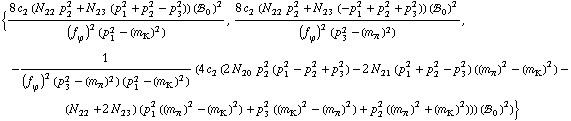
The new (as compared to the K->π amplitude) contributions with a weak counterterm vertex are proportional to the 'scalar' momentum and vanish when it's set to zero. The contributions with a leading order counterterm vertex are not proportional to the 'scalar' momentum and don't vanish when it's set to zero
![res1 /. {Pair[Momentum[p3], Momentum[p3]] -> Pair[Momentum[p1], Momentum[p1]], p2 -> 0} /. RenormalizationState[1] -> RenormalizationState[0] // Simplify](../HTMLFiles/index_92.gif)

Converted by Mathematica (July 10, 2003)