![Cases[amp4, CouplingConstant[__], Infinity] // Union // Renormalize](../HTMLFiles/index_60.gif)
The beta functions:

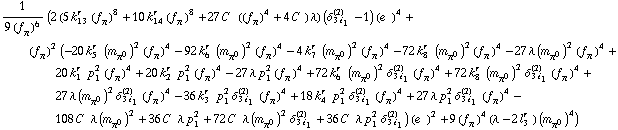
The contributions:
![ff2 = amp2 /. Momentum[p2] -> -Momentum[p1] // Simplify](../HTMLFiles/index_62.gif)

![amploop = ((Plus @@ ampinfinities /. Momentum[p3] -> -Momentum[p1]) // Simplify) /. delrules // Simplify](../HTMLFiles/index_64.gif)
![-1/(96 π^2) (1/((m _ π^+^(ó ))^2 - (m _ γ^(ó ))^2) (6 (-32 π^2 λ (m _ π^+^(ó ))^4 - log((m _ π^+^(ó ))^2/μ^2) (m _ π^+^(ó ))^4 + 32 π^2 λ (m _ γ^(ó ))^4 + log((m _ γ^(ó ))^2/μ^2) (m _ γ^(ó ))^4 + 16 π^2 Overscript[J, _] _ ((m _ π^+^(ó ))^2 (m _ γ^(ó ))^2)(p _ 1^2) ((m _ π^+^(ó ))^2 - (m _ γ^(ó ))^2) (2 (m _ π^+^(ó ))^2 - (m _ γ^(ó ))^2 + 2 p _ 1^2) + p _ 1^2 (2 (32 π^2 λ + log((m _ γ^(ó ))^2/μ^2)) (m _ γ^(ó ))^2 - 2 (32 π^2 λ + log((m _ π^+^(ó ))^2/μ^2)) (m _ π^+^(ó ))^2)) ((δ _ (1 i _ 1)^(2))^2 + (δ _ (2 i _ 1)^(2))^2) (e^( ))^2) - 12 (64 π^2 λ + 2 log((m _ γ^(ó ))^2/μ^2) + 1) (m _ γ^(ó ))^2 (δ _ (3 i _ 1)^(2) - 1) (e^( ))^2 - 1/(f _ π^(ó ))^4 (2 (32 π^2 λ + log((m _ π^+^(ó ))^2/μ^2)) ((f _ π^(ó ))^2 (-(δ _ (3 i _ 1)^(2) + 1) (m _ π^+^(ó ))^2 - (m _ π^0^(ó ))^2 (δ _ (3 i _ 1)^(2) - 2) - p _ 1^2 (δ _ (3 i _ 1)^(2) + 1)) - 4 C^( ) (e^( ))^2 (3 δ _ (3 i _ 1)^(2) - 4)) (m _ π^+^(ó ))^2 + (32 π^2 λ + log((m _ π^0^(ó ))^2/μ^2)) (m _ π^0^(ó ))^2 ((f _ π^(ó ))^2 ((4 δ _ (3 i _ 1)^(2) - 1) (m _ π^0^(ó ))^2 + 2 p _ 1^2 (δ _ (3 i _ 1)^(2) - 1)) - 4 C^( ) (e^( ))^2 (δ _ (3 i _ 1)^(2) - 1))))](../HTMLFiles/index_65.gif)
![ampwf4 = amp4 /. Momentum[p2] -> -Momentum[p1] // Renormalize // Simplify](../HTMLFiles/index_66.gif)
The full propagator (to fourth order) can be written 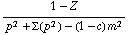 ~~
~~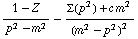 . Thus the amplitude
 ff4 can be written  .
.

We demand that ff4 be zero on the mass shell with  =
= , where
  =
=  +
+Cm is the renormalized mass. Since we are only working to O( ), we only need
 Cm to first order in  .
.
![Cm = (Collect[(-ff4 /. Pair[Momentum[p1], Momentum[p1]] -> ParticleMass[Pion, SUNIndex[i1], RenormalizationState[0]]^2 /. pimassrule), LeutwylerLambda[]] // SUNReduce[#, FullReduce -> True] & // Simplify) //. delrules // Simplify ;](../HTMLFiles/index_83.gif)
The mass shift is finite:
![Coefficient[Cm, LeutwylerLambda[]] /. $ChargeEliminate /. delrules // Simplify](../HTMLFiles/index_84.gif)

Here follow then the mass renormalization of the charged and neutral pions in terms of scale independent coupling constants (they agree with Knecht & Urech):
![CmPlus = (ILimit[Cm /. i1 -> 1, ParticleMass[Photon, RenormalizationState[0]] -> 0] // Simplify) // Simplify // ChargedNeutralMassesCancel](../HTMLFiles/index_86.gif)
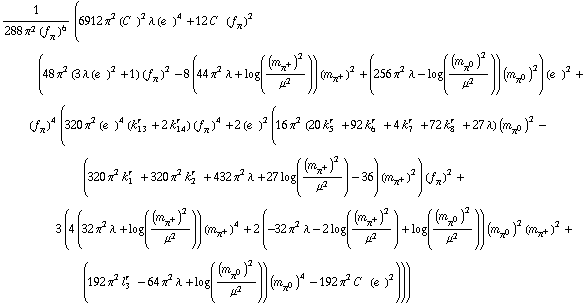

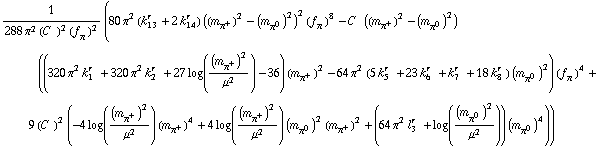
![CmZero = (ILimit[Cm /. i1 -> 3, ParticleMass[Photon, RenormalizationState[0]] -> 0] // Simplify) // collectk](../HTMLFiles/index_90.gif)
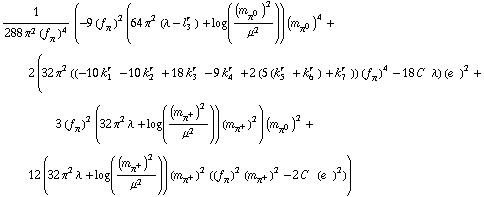
![Collect[CmZero /. $ChargeEliminate, _LeutwylerLambda] // Simplify](../HTMLFiles/index_92.gif)

EM counter-terms for easy comparison with Knecht & Urech
![(CmPlus - (CmPlus /. CouplingConstant[ChPTVirtualPhotons2[4], _, ___] -> 0) // FullSimplify) /. $ChargedMassesEliminate // FullSimplify](../HTMLFiles/index_94.gif)

![CmZero - (CmZero /. CouplingConstant[ChPTVirtualPhotons2[4], _, ___] -> 0) /. $ChargedMassesEliminate // FullSimplify](../HTMLFiles/index_96.gif)

Adding the mass shift to the full amputated two-point function,  times the two-point function (compare Urech's thesis formula 1.55), gives (1-Z)
 . Thus Z (plus the linear coefficient
 ![Overscript[Σ, _]](../HTMLFiles/index_100.gif) of
of  ) is found by dividing off
  and taking the limit
  .
.
![zz = (ff4 + Cm // SUNReduce[#, FullReduce -> True] &) /. delrules ;](../HTMLFiles/index_104.gif)

![z = ILimit[zzz, ParticleMass[Photon, RenormalizationState[0]] -> 0] // Simplify ;](../HTMLFiles/index_106.gif)
The neutral residue:
![zZero = z /. i1 -> 3 /. Pair[Momentum[p1], Momentum[p1]] -> ParticleMass[PionZero, RenormalizationState[0]] // Simplify](../HTMLFiles/index_107.gif)

The charged residue:

![zPlus = ILimit[ILimit[(zPlus1 // ChargeEliminate) /. LeutwylerJBar[a__, ___Rule] :> LeutwylerJBar[a, ExplicitLeutwylerSigma -> True, LeutwylerJBarEvaluation -> "subthreshold"], Pair[Momentum[p1], Momentum[p1]] -> ParticleMass[PionPlus, RenormalizationState[0]]^2], ParticleMass[Photon, RenormalizationState[0]] -> 0] // Simplify // ChargedNeutralMassesCancel // Simplify](../HTMLFiles/index_110.gif)

Check the strong part:

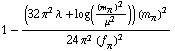

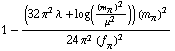
Finally, the non-linear part ![Overscript[Overscript[Σ, _], _](p^2)](../HTMLFiles/index_116.gif) of Σ
of Σ is found.
 ![Overscript[Overscript[Σ, _], _](p^2)](../HTMLFiles/index_118.gif) vanishes non-linearly for
vanishes non-linearly for  .
.
![sigmaZero = (ILimit[ff4 + CmZero - zZero (Pair[Momentum[p1], Momentum[p1]] - ParticleMass[PionZero, RenormalizationState[0]]^2) /. i1 -> 3, ParticleMass[Photon, RenormalizationState[0]] -> 0] // Simplify) // ChargedMassesEliminate // Simplify](../HTMLFiles/index_120.gif)

![sigmaPlus = (ILimit[ff4 + CmPlus - zPlus (Pair[Momentum[p1], Momentum[p1]] - ParticleMass[PionPlus, RenormalizationState[0]]^2) /. i1 -> 1, ParticleMass[Photon, RenormalizationState[0]] -> 0] // Simplify) // ChargeEliminate // Simplify // NeutralMassesEliminate // Simplify](../HTMLFiles/index_122.gif)
![-((e^( ))^2 ((16 π^2 Overscript[J, _] _ ((m _ π^+^(ó ))^2 (m _ γ^(ó ))^2)(p _ 1^2) - log((m _ γ^(ó ))^2/(m _ π^+^(ó ))^2) - 1) (m _ π^+^(ó ))^2 + (16 π^2 Overscript[J, _] _ ((m _ π^+^(ó ))^2 (m _ γ^(ó ))^2)(p _ 1^2) + log((m _ γ^(ó ))^2/(m _ π^+^(ó ))^2) - 1) p _ 1^2))/(8 π^2)](../HTMLFiles/index_123.gif)

![-((e^( ))^2 (16 π^2 Overscript[J, _] _ ((m _ π^+^(ó ))^2 (m _ γ^(ó ))^2)(p _ 1^2) - 1) ((m _ π^+^(ó ))^2 + p _ 1^2))/(8 π^2)](../HTMLFiles/index_125.gif)
![zFullZero = (sigmaZero + zZero (Pair[Momentum[p1], Momentum[p1]] - ParticleMass[PionZero, RenormalizationState[0]]^2))/(Pair[Momentum[p1], Momentum[p1]] - ParticleMass[PionZero, RenormalizationState[0]]^2) // FullSimplify](../HTMLFiles/index_126.gif)

![zFullPlus = FullSimplify /@ Collect[(sigmaPlus + zPlus (Pair[Momentum[p1], Momentum[p1]] - ParticleMass[PionPlus, RenormalizationState[0]]^2))/(Pair[Momentum[p1], Momentum[p1]] - ParticleMass[PionPlus, RenormalizationState[0]]^2) // Expand, {Pi, _DecayConstant, _CouplingConstant}] // FullSimplify](../HTMLFiles/index_128.gif)
![1/(144 π^2) (2 (9 (log((m _ π^+^(ó ))^2/μ^2) + (2 p _ 1^2)/(p _ 1^2 - (m _ π^+^(ó ))^2) - 2) + 8 π^2 (20 k _ 1^(r ) + 20 k _ 2^(r ) + 9 (λ + Overscript[J, _] _ ((m _ π^+^(ó ))^2 (m _ γ^(ó ))^2)(p _ 1^2) ((4 p _ 1^2)/((m _ π^+^(ó ))^2 - p _ 1^2) + 2)))) (e^( ))^2 + (3 (48 π^2 (f _ π^(ó ))^2 + (64 π^2 λ - log((m _ π^+^(ó ))^2/μ^2)) (m _ π^+^(ó ))^2 - (128 π^2 λ + log((m _ π^0^(ó ))^2/μ^2)) (m _ π^0^(ó ))^2))/(f _ π^(ó ))^2)](../HTMLFiles/index_129.gif)
Save for later use.

![CheckF[CmPlus, "ChPTVirtualPhotons2P30o2.Mass"] ;](../HTMLFiles/index_131.gif)



![CheckF[CmZero, "ChPTVirtualPhotons2P40o2.Mass"] ;](../HTMLFiles/index_135.gif)



![CheckF[z, "ChPTVirtualPhotons2P20o2.Fac"] ;](../HTMLFiles/index_139.gif)



![CheckF[zPlus, "ChPTVirtualPhotons2P30o2.Fac"] ;](../HTMLFiles/index_143.gif)



![CheckF[zZero, "ChPTVirtualPhotons2P40o2.Fac"] ;](../HTMLFiles/index_147.gif)




Converted by Mathematica (July 10, 2003)