 :
:Following 't Hooft and Veltman one easily obtains the following expression for :
![c0 = Integrate[1/(MandelstamU y) Log[ParticleMass[Pion, RenormalizationState[0]]^2/(MandelstamU y^2 + -MandelstamU y + ParticleMass[Pion, RenormalizationState[0]]^2)], {y, 0, 1}]](../HTMLFiles/index_29.gif)
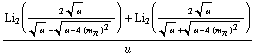
Now, according to the rule (Bürgi):  , we get finally for
  :
:
![c0 = 1/(2 s) Log[((s - 4 mPi^2)^(1/2) + s^(1/2))/((s - 4 mPi^2)^(1/2) - s^(1/2))]^2](../HTMLFiles/index_33.gif)
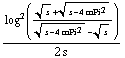
Apart from a factor 2i, the amplitude below is in agreement with Bijnens and Cornet (bugfixed - multiplied with a factor  ):
):
![MandelstamReduce[ampfinalpi0, OnMassShell -> True, Cancel -> MandelstamS, Masses -> {ParticleMass[Pion, RenormalizationState[0]], 0, ParticleMass[Pion, RenormalizationState[0]], 0}] /. {C0[__] -> c0, MandelstamU -> s, -p1 - p2 - p3 -> p4} // Simplify](../HTMLFiles/index_36.gif)

We can now insert some values for the contants and plot the cross section:
![valueRules = {ParticleMass[__] -> 137 10^6, DecayConstant[__] -> 134 10^6, mPi -> 137 10^6, mPi -> 137 10^6, fPi -> 134 10^6, α -> 1/137.036} ;](../HTMLFiles/index_38.gif)
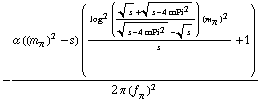
This is then the amplitude to be plotted:
![ampfinalpi00 = MandelstamReduce[ampfinalpi0, OnMassShell -> True, Cancel -> MandelstamS, Masses -> {ParticleMass[Pion, RenormalizationState[0]], 0, ParticleMass[Pion, RenormalizationState[0]], 0}] /. {C0[__] -> c0, CouplingConstant[QED[1], RenormalizationState[0]]^2 -> α 4 π, Pair[Momentum[Polarization[__], ___], Momentum[Polarization[__], ___]] -> 1} /. MandelstamU :> MandelstamS](../HTMLFiles/index_39.gif)
![β[s_] = (s - 4 mPi^2)/s^(1/2) ;](../HTMLFiles/index_41.gif)
![sigma00[ss_, z_] := 1/2 (2 π z)/(64 π^2 ss) β[ss] Abs[2 i ampfinalpi00]^2 /. {MandelstamS :> ss, s :> ss} /. valueRules](../HTMLFiles/index_42.gif)
![plot = Plot[0.38939 10^24 sigma00[e^2, 1.0], {e, (0.274 10^9), (0.7 10^9)}] ;](../HTMLFiles/index_43.gif)
![[Graphics:../HTMLFiles/index_44.gif]](../HTMLFiles/index_44.gif)
![0.38939 10^24 sigma00[(0.7 10^9)^2, 1.0]](../HTMLFiles/index_45.gif)

For comparison, here is Bijnens and Cornet's amplitude:
![amp00Bij[s_] := 4 i α 4 π mPi^2 1/(16 π^2 fPi^2) (1 - s/mPi^2) (1 + (s/mPi^2)^(-1) Log[((s/mPi^2 - 4)^(1/2) + s/mPi^2^(1/2))/((s/mPi^2 - 4)^(1/2) - s/mPi^2^(1/2))]^2) ;](../HTMLFiles/index_47.gif)
![sigma00Bij[s_, z_] := 1/2 (2 π z)/(64 π^2 s) β[s] Abs[amp00Bij[s]]^2 /. valueRules](../HTMLFiles/index_48.gif)
![plotBij = Plot[0.38939 10^24 sigma00Bij[e^2, 1.0], {e, (0.274 10^9), (0.7 10^9)}] ;](../HTMLFiles/index_49.gif)
![[Graphics:../HTMLFiles/index_50.gif]](../HTMLFiles/index_50.gif)
![0.38939 10^24 sigma00Bij[(0.7 10^9)^2, 1.0]](../HTMLFiles/index_51.gif)

And here is Holstein, Donoghue and Lin's cross section:
![zPlus[s_] := (1 + (1 - 4 mPi^2/s)^(1/2))/2](../HTMLFiles/index_53.gif)
![zMinus[s_] := (1 - (1 - 4 mPi^2/s)^(1/2))/2](../HTMLFiles/index_54.gif)
![fHol[s_] := 2 (Abs[Log[zPlus[s]/zMinus[s]]]^2 - π^2) + mPi^2/s (Abs[Log[zPlus[s]/zMinus[s]]]^2 + π^2)^2](../HTMLFiles/index_55.gif)
![sigma00Hol[s_] := α^2/(256 π^3 fPi^4) (s - mPi^2)^2/s (1 - (4 mPi^2)/s)^(1/2) (1 + mPi^2/s fHol[s]) /. valueRules](../HTMLFiles/index_56.gif)
![plotHol = Plot[{0.38939 10^24 4 sigma00Hol[e^2] /. valueRules, 0.38939 10^24 sigma00Bij[e^2, 1.0]}, {e, (0.274 10^9), (0.7 10^9)}] ;](../HTMLFiles/index_57.gif)
![[Graphics:../HTMLFiles/index_58.gif]](../HTMLFiles/index_58.gif)
All plots agree:
![Show[plot, plotBij, plotHol] ;](../HTMLFiles/index_59.gif)
![[Graphics:../HTMLFiles/index_60.gif]](../HTMLFiles/index_60.gif)
Converted by Mathematica (July 10, 2003)