 ->-
->- :
:FeynCalc counts all fields as incoming, so we substitute ->-:
![ff2 = amp2Pion /. Momentum[p2] -> -Momentum[p1]](../HTMLFiles/index_100.gif)

![ampwf4 = (amp4Pion /. Momentum[p2] -> -Momentum[p1] // Simplify)](../HTMLFiles/index_102.gif)



The full amplitude (to fourth order) ff4 differs from the lowest order amplitude ff4 by a factor Z, ff4 = 
ff2. This is equivalent to a redefinition of the pion field,  =
=  π.
π.

We may beautify this a bit:
![tt = (ff2 - Coefficient[ff2, Pair[Momentum[p1], Momentum[p1]]] Pair[Momentum[p1], Momentum[p1]]) + Collect[Coefficient[ff4, Pair[Momentum[p1], Momentum[p1]]], {_DecayConstant, _ParticleMass}] Pair[Momentum[p1], Momentum[p1]] + Plus @@ ((Collect[Coefficient[ff4, ParticleMass[#[[1]], RenormalizationState[0]]^2 ParticleMass[#[[2]], RenormalizationState[0]]^2], {_DecayConstant, _ParticleMass}] ParticleMass[#[[1]], RenormalizationState[0]]^2 ParticleMass[#[[2]], RenormalizationState[0]]^2) & /@ Union[Sort /@ (Flatten[Outer[List, {Pion, Kaon, EtaMeson}, {Pion, Kaon, EtaMeson}], 1])])](../HTMLFiles/index_110.gif)
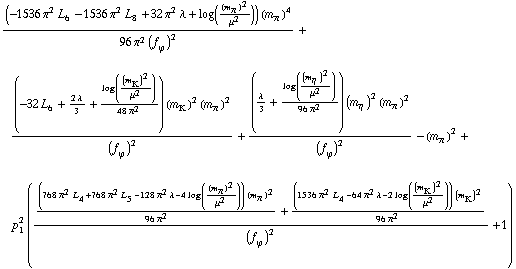


The factor Z can be directly read off the above expression as the coefficient of  .
.
![z = Collect[Coefficient[ff4, Pair[Momentum[p1], Momentum[p1]]], {_DecayConstant, _ParticleMass}] // FullSimplify](../HTMLFiles/index_115.gif)


![CheckF[z, "ChPT3P20o2.Fac"] ;](../HTMLFiles/index_118.gif)



Now we demand that ff4 be zero on the mass shell with  =
= , where
  =
=  +
+Cm is the renormalized mass. Since we are only working to O( ), we only need
 Cm to first order in  .
.
![CMPion = -ff4 /. Pair[Momentum[p1], Momentum[p1]] -> ParticleMass[Pion, RenormalizationState[0]]^2 /. fromEtaRules /. udrules // FullSimplify](../HTMLFiles/index_128.gif)

![CMrenPion = Renormalize[CMPion] // FullSimplify](../HTMLFiles/index_130.gif)

![CheckF[CMrenPion, "ChPT3P20o2.Mass"] ;](../HTMLFiles/index_132.gif)



![Coefficient[CMrenPion, LeutwylerLambda[]] // Simplify](../HTMLFiles/index_136.gif)

Converted by Mathematica (July 10, 2003)