 (-
(- +
+  )
) 
We now want to express the result as
(- + )
with X anti-hermitian and Y hermitian and
 =
= 
 +
+  .
.
That is, as
 (-
(-

 -
- 
 -
-  (
( ) - 2
) - 2 
 +
+  )
)  .
.
The third term doesn't contribute because of the anti-hermiticity of X.
![dd = sss - (sss /. {QuantumField[PartialD[a_], Particle[UPerturbation], ___][_] * QuantumField[PartialD[b_], Particle[UPerturbation], ___][_] -> 0, QuantumField[PartialD[a_], Particle[UPerturbation], ___][_]^2 -> 0}) // IndicesCleanup](../HTMLFiles/index_65.gif)



The non-derivative part of the Y and X contribution.
![xxy = sss /. QuantumField[PartialD[LorentzIndex[_]], __][x] -> 0 // FullSimplify](../HTMLFiles/index_69.gif)
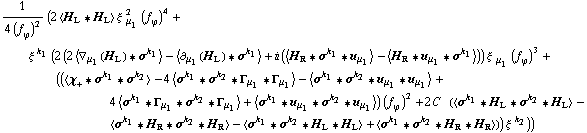
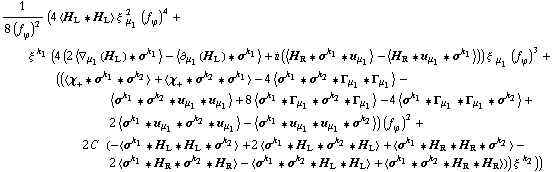
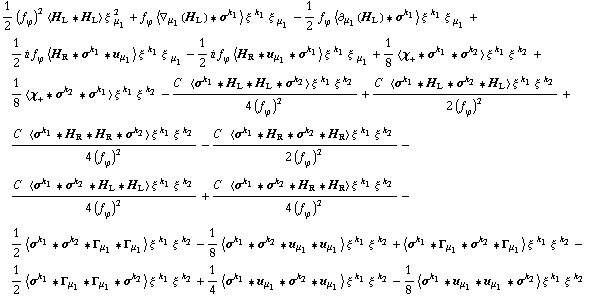
We may split this in a symmetric and an anti-symmetric part of which only the symmetric part contributes:
![xxyS = (If[yo = Sort[Union[Cases[#, SUNIndex[__], Infinity, Heads -> True]]] ; yo === {SUNIndex[k1], SUNIndex[k2]}, Symmetrize[#, {k1, k2}], #] & /@ Expand[NMExpand[xxy]]) // CycleUTraces // FullSimplify](../HTMLFiles/index_71.gif)

The part 2 :
:
![Expand[sss - xxy - dd // IndicesCleanup // CycleUTraces]](../HTMLFiles/index_76.gif)

![xd = Expand[sss - xxy - dd // IndicesCleanup // CycleUTraces] /. kroneckerRules](../HTMLFiles/index_78.gif)

X:
![X[Sequence @@ ((Pattern1[#[[1]], Blank[]] & /@ Union[Cases[xd, LorentzIndex[__], Infinity, Heads -> True]]) /. Pattern1 -> Pattern)] = -xd/2 /. QuantumField[___, Particle[UPerturbation], ___][x] -> 1 // Simplify](../HTMLFiles/index_80.gif)

Componentized version:
![X[Sequence @@ ((Pattern1[#[[1]], Blank[]] & /@ Union[Cases[X[μ1], SUNIndex[__], Infinity, Heads -> True]]) /. Pattern1 -> Pattern), μ1_] = X[μ1] ;](../HTMLFiles/index_82.gif)
The square of X.
![XX = (NM[X[k1, j, μ1], X[j, k2, μ1]] // NMExpand // Expand // CommutatorReduce // SUNReduce // CycleUTraces // CommutatorReduce // Expand) //. projectionRules // Simplify](../HTMLFiles/index_83.gif)

![xx = QuantumField[Particle[UPerturbation], SUNIndex[k1]][x] XX QuantumField[Particle[UPerturbation], SUNIndex[k2]][x] // HLeftRightTrick // NMExpand // Expand // IndicesCleanup // CycleUTraces // Simplify](../HTMLFiles/index_85.gif)

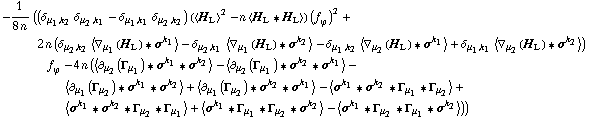
The field strength associated with X is [ ,
, ] times the field strength associated with Γ:
![XFST[k1_, k2_, μ1_, μ2_] = (FieldDerivative[X[k1, k2, μ2], x, {μ1}] - FieldDerivative[X[k1, k2, μ1], x, {μ2}] + NM[X[k1, j, μ1], X[j, k2, μ2]] - NM[X[k1, j, μ2], X[j, k2, μ1]] // NMExpand // Expand // CommutatorReduce // SUNReduce // CycleUTraces // IndicesCleanup[#, IsoDummys -> {"j", "j", "j"}] & // CommutatorReduce // Expand) //. projectionRules // HLeftRightTrick // NMExpand // Expand // IndicesCleanup[#, IsoDummys -> {"j", "j", "j"}] & // CycleUTraces // Simplify](../HTMLFiles/index_89.gif)
The parts coming from Y:
![y = (Expand[NMExpand[(xxyS) + xx]] // NMExpand // Expand // CycleUTraces) //. {KroneckerDelta[a_LorentzIndex, b_SUNIndex] c_ :> (c /. {b -> a}), KroneckerDelta[b_SUNIndex, a_LorentzIndex] c_ :> (c /. {b -> a})} // NMExpand // Expand // CycleUTraces // IndicesCleanup // UReduce // Expand](../HTMLFiles/index_91.gif)
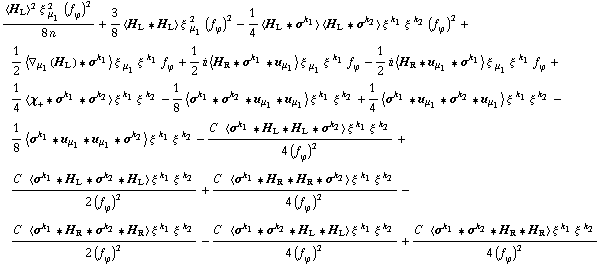
![y0 = (Select[y, (! FreeQ[#, QuantumField[Particle[UPerturbation], LorentzIndex[_]][_]]) &] + Symmetrize[Select[y, FreeQ[#, QuantumField[Particle[UPerturbation], LorentzIndex[_]][_]] &], {k1, k2}] // CycleUTraces) /. kroneckerRules1 // Expand](../HTMLFiles/index_93.gif)
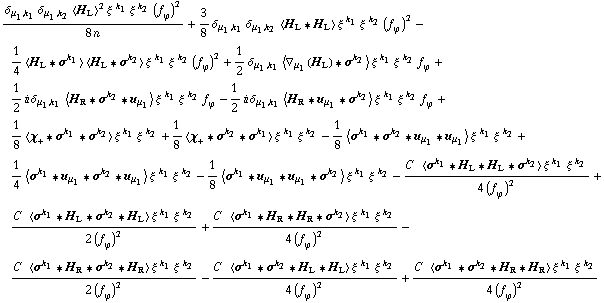
![y1 = Symmetrize[Select[y0, (Count[#, _KroneckerDelta, Infinity] === 1) &], {k1, k2}] + Select[y0, (Count[#, _KroneckerDelta, Infinity] =!= 1) &] // FullSimplify](../HTMLFiles/index_95.gif)
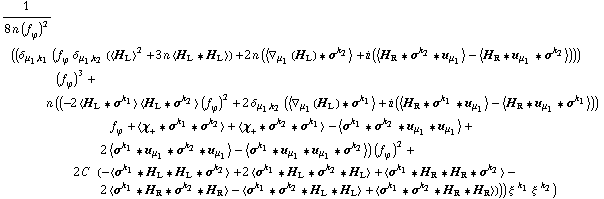
Componentized version:
![Y[k1_, k2_] = y1 /. QuantumField[___, Particle[UPerturbation], SUNIndex[_]][x] -> 1 ;](../HTMLFiles/index_97.gif)
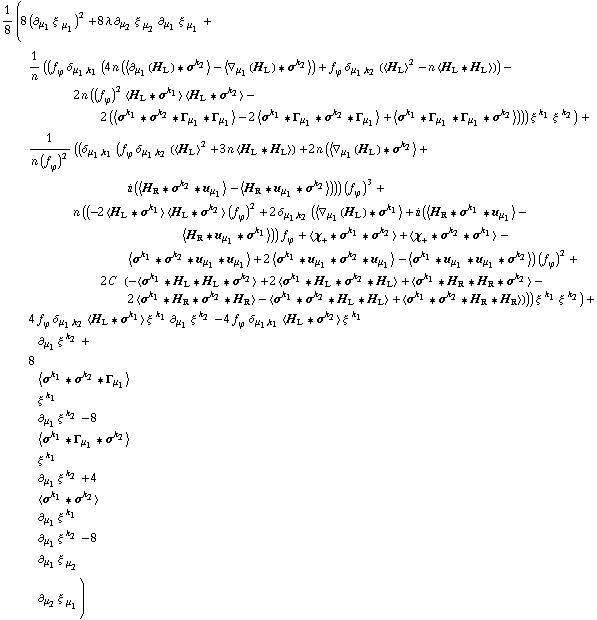
The result can then be written:

Converted by Mathematica (July 10, 2003)