![Needs["HighEnergyPhysics`FeynCalc`"] ;](HTMLFiles/index_2.gif)
FeynCalc 4.2.0
For help, type ?FeynCalc,
use the built-in help system
or visit www.feyncalc.org
Loading PHI
Loading FeynArts





PHI comes with the functions VeltmanB0 and VeltmanC0. VeltmanB0 is not really problematic. The implementation of VeltmanC0 is only a first attempt at implementing the formulae from 't Hooft and Veltman directly in Mathematica. It seems to be relatively successfull, but in general, it is recomended to use LoopTools for numerical evaluations of C0 as it is much more well tested.
![TruncatedGamma[d, 0, 4] // Simplify](HTMLFiles/index_8.gif)

![Plot[{Gamma[2 - d/2], TruncatedGamma[2 - d/2, 0, 2]}, {d, 0.0001, 17}, PlotStyle -> {{RGBColor[1, 0, 0]}, {RGBColor[0, 1, 0]}}] ;](HTMLFiles/index_10.gif)
![[Graphics:HTMLFiles/index_11.gif]](HTMLFiles/index_11.gif)
![Options[A0]](HTMLFiles/index_12.gif)

![SetOptions[A0, A0ToB0 -> False] ;](HTMLFiles/index_14.gif)
This is minus the definition of  of Passarino and Veltman (equation D.1):
![FeynAmpDenominator[PropagatorDenominator[Momentum[q1, D], ParticleMass[2]]]](HTMLFiles/index_16.gif)

FeynCalc however, returns  , so the
  of FeynCalc is minus the
  of Passarino and Veltman:
![oon = OneLoop[q1, %]](HTMLFiles/index_21.gif)

![SetOptions[A0, A0ToB0 -> True] ;](HTMLFiles/index_23.gif)
This is the definition of i 
 of Passarino and Veltman (equation D.2):
![fad = FeynAmpDenominator[PropagatorDenominator[Momentum[q1, D], ParticleMass[2]], PropagatorDenominator[Momentum[q1, D] - Momentum[p, D], ParticleMass[1]]]](HTMLFiles/index_26.gif)
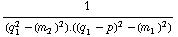
FeynCalc agrees with Passarino and Veltman:
![oon = OneLoop[q1, fad]](HTMLFiles/index_28.gif)

PHI expands  according to equation (5.4.a) of appendix C of Donoghue, Golowich and Holstein:
![VeltmanExpand[oon, MassScale -> 1, B0Evaluation -> "direct1", ExpandGammas -> False, TaylorOrder -> 1, DimensionExpand -> False] // Simplify](HTMLFiles/index_31.gif)
![i π^(D/2) Γ (2 - D/2) Underoverscript[∫, 0, arg3] (x (m _ 1^(ó ))^2 - (x - 1) (m _ 2^(ó ))^2 - i ϵ + (x - 1) x p^2)^(D - 4)/2 d x](HTMLFiles/index_32.gif)
Or using the algorithm of Todd West, which gives the same result (after multiplying I^(D/2)=(-1)^((D-4)/2) on the integrand):
![FeynmanParameterize[fad, q1] // Simplify](HTMLFiles/index_33.gif)

This is  of Passarino and Veltman ('t Hooft and Veltman section 3):
![a0 = 1/(I * Pi^2) * I * Pi^(SpaceTimeDimensions/2)/((ParticleMass[1]^2))^(1 - SpaceTimeDimensions/2) * Gamma[1 - D/2]](HTMLFiles/index_36.gif)
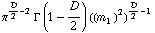

This is the expanded  of Passarino and Veltman:
![DiscardOrders[(((δ^2 * a0 // DimensionExpand[#, TaylorOrder -> 1] & // ExpandGammas[#, TaylorOrder -> 2] &) /. SpaceTimeDimensions -> D) /. D -> 4 - δ) /. _ParticleMass -> m, PerturbationOrder -> 2]/δ^2 // Simplify // Expand](HTMLFiles/index_40.gif)

This is the  of FeynCalc evaluated with PHI:
![(VeltmanExpand[A0[m^2], MassScale -> 1, SmallEpsilon -> 0.00001, B0Evaluation -> "direct1", ExpandGammas -> False, TaylorOrder -> 1] // DimensionExpand[#, TaylorOrder -> 1] &) /. IntegrateHeld -> Integrate // Simplify](HTMLFiles/index_43.gif)

This is the expanded  of FeynCalc evaluated with PHI, exactly minus the above:
![DiscardOrders[((((((δ^2 * A0[ParticleMass[m]^2] // VeltmanExpand[#, MassScale -> 1, B0Evaluation -> "direct1", ExpandGammas -> True, TaylorOrder -> 2, SmallEpsilon -> 0] &) /. IntegrateHeld -> Integrate) // DimensionExpand[#, TaylorOrder -> 1] &) /. SpaceTimeDimensions -> D) /. D -> 4 - δ)) /. _ParticleMass -> m, PerturbationOrder -> 2]/δ^2 // Simplify // Expand](HTMLFiles/index_46.gif)

With Δ = - + γ -ln(π), the
  (
( ) of LoopTools is -
 (
( ) -
) -  , where
  is the
  of Passarino and Veltman (which is minus the
  of FeynCalc):
Notice: To load LoopTools, get it, and change the path appropiately. Loading it makes A0 and B0 (and D0 and E0) return explicit values.
![looptools = Install["LoopTools"] ;](HTMLFiles/index_57.gif)
![A0[1]](HTMLFiles/index_60.gif)
![A0[2]](HTMLFiles/index_63.gif)
![2 - 2 Log[2] // N](HTMLFiles/index_64.gif)

The  of LoopTools is the
  -
- :
:
Here is the definition of Passarino and Veltman of  -
- . The logarithm is to be taken just below the real axis:
![Plot3D[Im[Log[x + I * y]], {x, -1, 1}, {y, -1, 1}] ;](HTMLFiles/index_71.gif)
![[Graphics:HTMLFiles/index_72.gif]](HTMLFiles/index_72.gif)
![B0[1, 0, 0]](HTMLFiles/index_73.gif)

![-NIntegrate[Log[1 x^2 - 1 x - i 0.00000001], {x, 0, 1}]](HTMLFiles/index_75.gif)

![B0[2, 0, 0]](HTMLFiles/index_77.gif)

![-NIntegrate[Log[2 x^2 - 2 x - i 0.00000001], {x, 0, 1}]](HTMLFiles/index_79.gif)

![Uninstall[looptools] ;](HTMLFiles/index_81.gif)
The VeltmanB0 of PHI returns an explicit expression for the B0 of FeynCalc. VeltmanDelta[4-D] is similar to the  above, but with -γ instead of γ (for some reason my expansion of the gamma function gives this -γ):
![v1 = (VeltmanB0[1, 0, 0, B0Evaluation -> "direct1", SmallEpsilon -> 0.000001, DimensionExpand -> True, FCIntegrate -> NIntegrate, MassScale -> 1, ExpandGammas -> True]) /. D -> 4 - δ // Simplify](HTMLFiles/index_83.gif)

![Limit[v1 - VeltmanDelta[δ], δ -> 0] // N](HTMLFiles/index_85.gif)

![v2 = (VeltmanB0[2, 0, 0, B0Evaluation -> "direct1", SmallEpsilon -> 0.000001, DimensionExpand -> True, FCIntegrate -> NIntegrate, MassScale -> 1, ExpandGammas -> True]) /. D -> 4 - δ // Simplify](HTMLFiles/index_87.gif)

![Limit[v2 - VeltmanDelta[δ], δ -> 0] // N](HTMLFiles/index_89.gif)

This is minus the definition of i 
 of Passarino and Veltman (equation E.1):
![FeynAmpDenominator[PropagatorDenominator[Momentum[q1, D], ParticleMass[1]], PropagatorDenominator[Momentum[q1, D] - Momentum[p1, D], ParticleMass[2]], PropagatorDenominator[Momentum[q1, D] - Momentum[p1, D] - Momentum[p2, D], ParticleMass[3]]]](HTMLFiles/index_93.gif)

FF (LoopTools) follows Passarino and Veltman, whereas FeynCalc's definition is minus the definition of Passarino and Veltman:
![oon = OneLoop[q1, %]](HTMLFiles/index_95.gif)

![Plot3D[Im[Spence[x + I * y]], {x, -1, 3}, {y, -1, 1}, PlotPoints -> 20] ;](HTMLFiles/index_97.gif)
![[Graphics:HTMLFiles/index_98.gif]](HTMLFiles/index_98.gif)
![Plot3D[Re[Spence[x + I * y]], {x, -1, 3}, {y, -1, 1}, PlotPoints -> 20] ;](HTMLFiles/index_99.gif)
![[Graphics:HTMLFiles/index_100.gif]](HTMLFiles/index_100.gif)
![Plot[Re[Spence[x]], {x, -1, 3}] ;](HTMLFiles/index_101.gif)
![[Graphics:HTMLFiles/index_102.gif]](HTMLFiles/index_102.gif)
![f[p12_, p20_] := VeltmanC0[10, p20, p12, 1, 1, 1, C0Evaluation -> "Spence", SmallEpsilon -> 0.0000001]](HTMLFiles/index_103.gif)
![Plot3D[Re[f[x, y]], {x, -100, 100}, {y, -100, 100}, PlotPoints -> 20] ;](HTMLFiles/index_104.gif)
![[Graphics:HTMLFiles/index_105.gif]](HTMLFiles/index_105.gif)
![Plot3D[Im[f[x, y]], {x, -100, 100}, {y, -100, 100}, PlotPoints -> 20] ;](HTMLFiles/index_106.gif)
![[Graphics:HTMLFiles/index_107.gif]](HTMLFiles/index_107.gif)
This is a sample infrared FF (LoopTools) plot:
These are sample infrared FF (LoopTools) plots and PHI plots with Spence evaluation and the simpler Infrared evaluations (also using Spence functions, but only two):
![looptools = Install["LoopTools"] ;](HTMLFiles/index_108.gif)
![Plot[Re[C0[200, 700, 400, 200, d, 700]], {d, 0.01, 3}] ;](HTMLFiles/index_109.gif)
![[Graphics:HTMLFiles/index_110.gif]](HTMLFiles/index_110.gif)
![Plot[{-Re[VeltmanC0[200, 700, 400, 200, d, 700, C0Evaluation -> "infrared", SmallEpsilon -> 0.00001]], -Re[VeltmanC0[200, 700, 400, 200, d, 700, C0Evaluation -> "Spence", SmallEpsilon -> 0.00001]]}, {d, 0.01, 3}, PlotStyle -> {{RGBColor[1, 0, 0]}, {RGBColor[0, 1, 0]}, {RGBColor[0, 0, 1]}}] ;](HTMLFiles/index_111.gif)
![[Graphics:HTMLFiles/index_112.gif]](HTMLFiles/index_112.gif)
![Plot[Im[C0[200, 700, 400, 200, d, 700]], {d, 0.01, 3}] ;](HTMLFiles/index_113.gif)
![[Graphics:HTMLFiles/index_114.gif]](HTMLFiles/index_114.gif)
![Plot[{-Im[VeltmanC0[200, 700, 400, 200, d, 700, C0Evaluation -> "infrared", SmallEpsilon -> 0.00001]], -Im[VeltmanC0[200, 700, 400, 200, d, 700, C0Evaluation -> "Spence", SmallEpsilon -> 0.00001]]}, {d, 0.01, 3}, PlotStyle -> {{RGBColor[1, 0, 0]}, {RGBColor[0, 1, 0]}, {RGBColor[0, 0, 1]}}] ;](HTMLFiles/index_115.gif)
![[Graphics:HTMLFiles/index_116.gif]](HTMLFiles/index_116.gif)
![Plot[Re[C0[200, 200, 4000, 200, d, 200]], {d, 0.01, 3}] ;](HTMLFiles/index_117.gif)
![[Graphics:HTMLFiles/index_118.gif]](HTMLFiles/index_118.gif)
![Plot[{-Re[VeltmanC0[200, 200, 4000, 200, d, 200, C0Evaluation -> "infrared", SmallEpsilon -> 0.00001]], -Re[VeltmanC0[200, 200, 4000, 200, d, 200, C0Evaluation -> "infrared2", SmallEpsilon -> 0.00001, ExplicitLeutwylerSigma -> True]], -Re[VeltmanC0[200, 200, 4000, 200, d, 200, C0Evaluation -> "Spence", SmallEpsilon -> 0.00001]]}, {d, 0.01, 3}, PlotStyle -> {{RGBColor[1, 0, 0]}, {RGBColor[0, 1, 0]}, {RGBColor[0, 0, 1]}}] ;](HTMLFiles/index_119.gif)
![[Graphics:HTMLFiles/index_120.gif]](HTMLFiles/index_120.gif)
![Plot[Im[C0[200, 200, 8000, 200, d, 200]], {d, 0.01, 3}] ;](HTMLFiles/index_121.gif)
![[Graphics:HTMLFiles/index_122.gif]](HTMLFiles/index_122.gif)
![Plot[{-Im[VeltmanC0[200, 200, 8000, 200, d, 200, C0Evaluation -> "infrared", SmallEpsilon -> 0.00001]], -Im[VeltmanC0[200, 200, 8000, 200, d, 200, C0Evaluation -> "infrared2", SmallEpsilon -> 0.00001, ExplicitLeutwylerSigma -> True]], -Im[VeltmanC0[200, 200, 8000, 200, d, 200, C0Evaluation -> "Spence", SmallEpsilon -> 0.00001]]}, {d, 0.01, 3}, PlotStyle -> {{RGBColor[1, 0, 0]}, {RGBColor[0, 1, 0]}, {RGBColor[0, 0, 1]}}] ;](HTMLFiles/index_123.gif)
![[Graphics:HTMLFiles/index_124.gif]](HTMLFiles/index_124.gif)
Sample valuation with FF (LoopTools):
![C0[2000, 400, 6000, 2005, 400, 800]](HTMLFiles/index_125.gif)

![Uninstall[looptools] ;](HTMLFiles/index_127.gif)
The different numeric evaluations of PHI are generally unreliable:
![-VeltmanC0[2000, 400, 6000, 2005, 400, 800, C0Evaluation -> "direct1", SmallEpsilon -> 0.000000001]](HTMLFiles/index_128.gif)

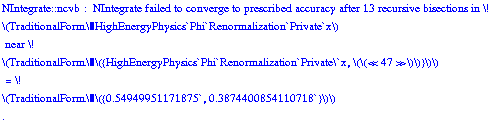

![-VeltmanC0[2000, 400, 6000, 2005, 400, 800, C0Evaluation -> "direct2", SmallEpsilon -> 0.000000001]](HTMLFiles/index_132.gif)


![-VeltmanC0[2000, 400, 6000, 2005, 400, 800, C0Evaluation -> "direct3", SmallEpsilon -> 0.00000000001] // N](HTMLFiles/index_135.gif)


Direct4 fails in this region of parameter space because Mathematica does not automatically implement the right cut:
![-VeltmanC0[2000, 400, 6000, 2005, 400, 800, C0Evaluation -> "direct4", SmallEpsilon -> 0.00000000001] // N](HTMLFiles/index_138.gif)

Spence is the most generally reliable and fast of the PHI options:
![-VeltmanC0[2000, 400, 6000, 2005, 400, 800, C0Evaluation -> "Spence", SmallEpsilon -> 0.00000000001] // N](HTMLFiles/index_140.gif)

Converted by Mathematica (July 10, 2003)